Colposcopy and its Role in Diagnosing Cervical Diseases
Colposcopy is one of the important and specialized methods for diagnosing cervical diseases, performed for a detailed examination of the cervix, vagina, and the external female genital area. In this method, the physician uses a device called a colposcope; a microscope-like instrument that provides 6 to 40 times magnification, allowing for precise observation of cellular and vascular changes.
This method plays a significant role in the early detection of pre-cancerous lesions and cervical cancer and is considered one of the most effective tools for preventing the progression of the disease.
How is Colposcopy performed?
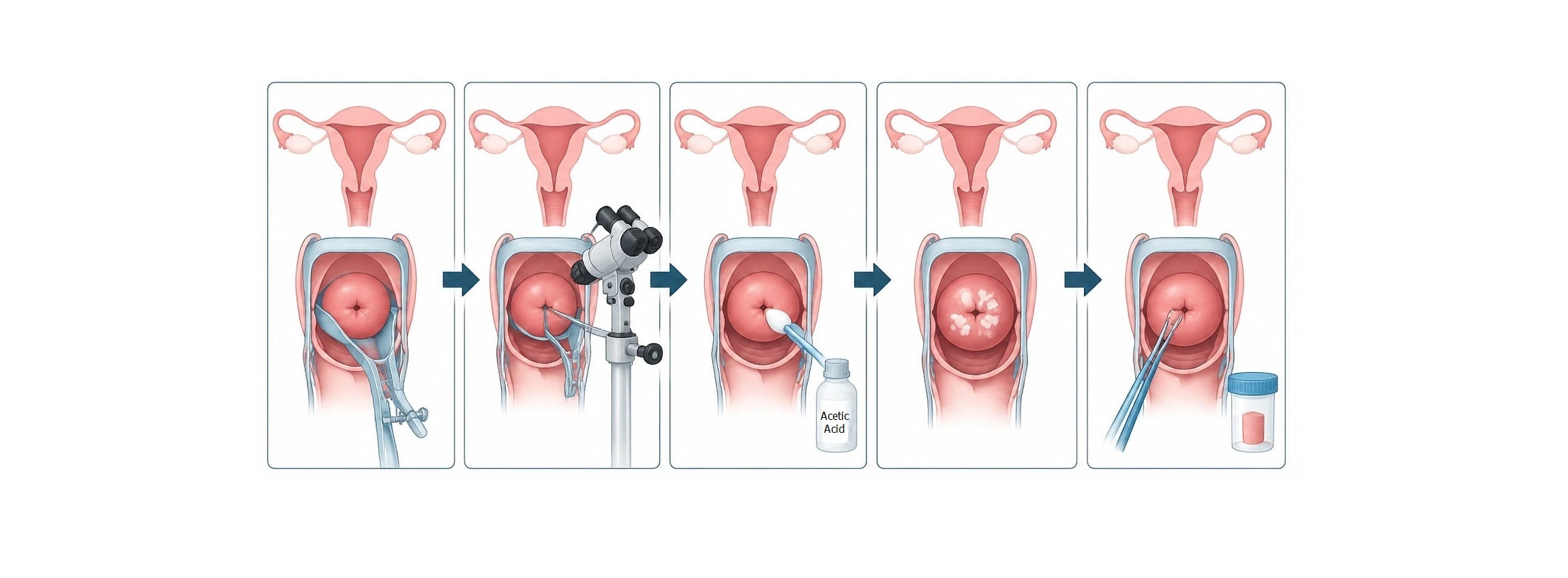
Colposcopy is usually performed without the need for anesthesia and takes about 10 to 20 minutes. The steps involved are as follows:
1. The patient lies on the gynecological examination table.
2. The physician uses a speculum to make the cervix visible.
3. The colposcope is placed outside the body and examines the cervix with magnification without direct contact.
4. For better diagnosis, a 3% to 5% acetic acid solution is applied to the cervix; abnormal areas turn white, which is called Acetowhite changes.
5. In the next step, Lugol's iodine (Schiller's test) may be used; normal cells turn brown, while abnormal cells remain unstained.
6. If suspicious areas are observed, the physician performs a biopsy for pathological examination.
After the colposcopy, the patient can usually resume daily activities.
The Role of Colposcopy in Diagnosing Cervical Diseases
1. Evaluation of Abnormal Pap Smear Results
If a Pap smear test indicates the presence of abnormal cells, a colposcopy is performed to determine the location, severity, and type of the lesion.
2. Diagnosis of Pre-cancerous Lesions (CIN)
Colposcopy can identify pre-cancerous cellular changes. If left untreated, these lesions may develop into cervical cancer in the future.
3. Early Detection of Cervical Cancer
Suspicious changes such as sores, epithelial discoloration, or abnormal blood vessels are visible during a colposcopy, and early diagnosis increases the chances of successful treatment.
4. Evaluation of HPV Infection
Some lesions caused by the HPV virus create specific patterns, such as mosaic or punctate changes, which are detectable during a colposcopy.
5. Follow-up After Treatment
After the treatment of cervical lesions such as cryotherapy, LEEP, or conization, a colposcopy is performed to ensure the complete removal of the lesion and to check for the possibility of disease recurrence.
Indications for Referral to Colposcopy
The physician may recommend a colposcopy in the following conditions:
• Abnormal Pap smear results such as:
ASC-US
LSIL
HSIL
AGC
• Positive high-risk HPV test
• Observation of sores, bumps, or abnormal discoloration on the cervix
• Abnormal uterine bleeding or post-coital bleeding
• History of pre-cancerous lesions or cervical cancer
• Follow-up after treatment of cervical lesions
Advantages of Colposcopy
• A non-invasive and safe method
• High accuracy in diagnosing lesions
• Possibility of targeted biopsy from suspicious areas
• Aid in the early detection of cervical cancer
Limitations of Colposcopy
• Interpretation of results depends on the physician's skill and experience.
• Some very subtle or sub-surface changes may not be visible.
Conclusion
Colposcopy is one of the most accurate diagnostic methods for cervical diseases, playing a key role in identifying pre-cancerous lesions, early detection of cancer, and evaluating HPV infection. Timely performance of this procedure, especially after abnormal Pap smear results, can be very effective in preventing cervical cancer and maintaining women's health.
| Feature | Pap Smear | Colposcopy |
|---|---|---|
| Type of Method | Screening test (Simple, initial) | Precise diagnostic method |
| Main Goal | Early discovery of suspicious cellular changes | Examination and determination of the exact nature of lesions and selection of the appropriate site for biopsy |
| Application | Initial cervical cancer screening | Confirmation of abnormal Pap smear or HPV test results, diagnosis of pre-cancerous and cancerous lesions |
| Accuracy Level | Limited sensitivity (small or hidden lesions may not be seen) | Very high accuracy, possibility of observing vascular and cellular patterns |
| Biopsy Capability | None | Yes (Targeted biopsy from suspicious area) |
| Duration | Quick (few minutes) | Slightly longer (10–20 minutes) |
| Cost | Lower | Higher (due to required equipment and expertise) |
| Primary Use Case | Routine screening for women | Detailed evaluation after abnormal Pap smear or HPV test results |